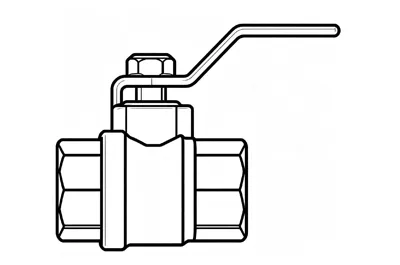
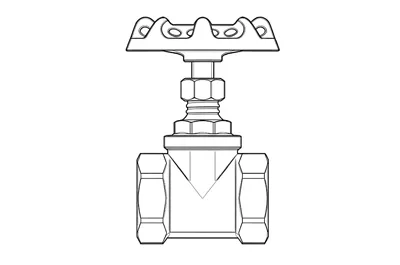
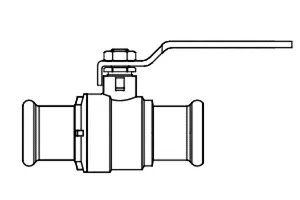

If today's engineers were asked to choose one type of valve as the primary choice for industrial systems, many would not hesitate to choose the ball valve.
They offer fast opening and closing, easy automation, compact structure, and simple maintenance.
From the perspective of modern industry, the ball valve seems naturally more advanced than the gate valve.
But if you go back 100 years, you will find that this was not the case at all.
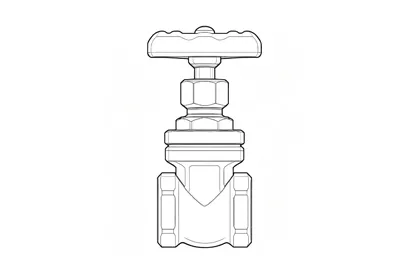
For a long period, the gate valve virtually dominated the entire industrial world. From urban water supply to steam boilers, from mining transport to oil pipelines, from the shipbuilding industry to thermal power generation, wherever there were large pipeline systems, the gate valve could almost always be found.
It was not only one of the most important valves of the Industrial Revolution, but also the foundation upon which modern fluid control technology developed.
Here is the question.
Why could a product with slow opening and closing, a bulky size, and less than outstanding automation performance dominate the industrial world for more than a century?
The answer does not lie in how advanced the gate valve was, but in the fact that it perfectly met the core needs of its era.
I. What kind of valve did the Industrial Revolution need?
To understand the success of the gate valve, we must first understand the industrial environment of the time.
The industrial systems of the nineteenth century were completely different from those of today.
At that time, there was no building automation, no PLC control, and certainly no smart actuators. A large number of factories relied on steam power, and pipeline systems were growing ever larger, yet the control logic was very simple.
The vast majority of valves had only two states:
They were either fully open or fully closed.
The question engineers cared about most was not control precision, but whether a large volume of fluid could pass through smoothly.
Against this background, the advantages of the gate valve were magnified enormously.
When the gate is fully raised, the fluid passes through the valve body almost in a straight line, with no obvious obstruction in between. Compared with products such as globe valves, the gate valve offers very low flow resistance.
For factories driven by steam, every reduction in pressure drop meant higher energy efficiency.
Many people today talk about energy saving, but engineers more than a hundred years ago were thinking about the same issue.
They simply adopted a more direct approach: reduce system resistance as much as possible.
And the gate valve did exactly that.
II. An overlooked advantage: the larger the size, the greater the value
Many young engineers work with valve sizes typically ranging from DN15 to DN100 (nominal diameter).
But during the Industrial Revolution, a large number of engineering projects used extremely large-diameter pipelines.
For large-diameter systems, the flow capacity of a valve is far more important than its opening and closing speed.
The gate valve has a natural advantage—full bore, meaning the flow passage matches the pipeline internal diameter.
When the gate is fully open, the flow passage is almost consistent with that of the pipeline.
This means that at the same nominal size, a gate valve can provide higher flow capacity.
If you look back a hundred years, you will find that many large water supply projects, mine drainage projects, and steam transmission systems were all pursuing one thing:
Let more fluid pass through.
Not make the valve act faster.
Therefore, large-diameter applications naturally became the main battlefield for gate valves.
Even today, in many ultra-large-diameter water transmission projects, gate valves still hold an important position.
III. Material technology determined the choice of the era
Many people believe that the ball valve inevitably replaced the gate valve.
In fact, that is not the case.
Without breakthroughs in material technology, modern ball valves could never have become widely adopted.
The reason today's ball valves can achieve low-torque operation depends to a large extent on high-performance sealing materials such as PTFE.
But in the nineteenth century and the early twentieth century, these materials did not exist at all.
The common sealing methods at the time mainly relied on metal contact or simple packing.
Under such conditions, both ball valves and plug valves faced enormous friction problems.
Particularly as diameters increased, operating torque rose sharply.
By contrast, the gate valve adopted a vertical lifting structure, avoiding the enormous friction caused by rotary sealing.
Given the technical conditions of the time, the gate valve was actually the more advanced and more reliable solution.
This also illustrates a rule:
The victory or defeat of many technical routes is not determined by structure, but by materials.
The rise and fall of countless products in industrial history follow this logic.
IV. Why did power plants particularly favor gate valves?
If you study the history of the thermal power industry, you will find that gate valves long occupied a core position.
The reason is simple.
Steam systems place extremely demanding requirements on valves.
High temperature, high pressure, and long-term continuous operation.
Under such working conditions, soft sealing materials can hardly survive.
Gate valves, however, use metal sealing structures and can withstand extremely high temperatures.
More importantly, in the fully open state, the valve seats are subjected to relatively little erosion over time.
This means a longer service life.
For power generation equipment that needs to run continuously for tens of thousands of hours, reliability always comes first.
Even today, in ultra-high-temperature steam systems, gate valves still hold an irreplaceable position.
V. The gate valve's real enemy is not the ball valve
Many people see the gate valve and the ball valve as competitors.
In fact, for a long period, the gate valve's biggest competitor was the globe valve.
Because both were born during the Industrial Revolution.
The globe valve offers better sealing performance, but higher flow resistance.
The gate valve offers lower flow resistance, but slower action.
Engineers needed to choose according to the specific working conditions.
This competition lasted for decades.
It was not until the mid-to-late twentieth century that the ball valve began to rise rapidly.
The ball valve inherited some of the advantages of both almost at the same time.
It offers both relatively low flow resistance and fast opening and closing capability.
Coupled with the arrival of the automation era, the market landscape began to change.
Many fields that originally belonged to gate valves were gradually replaced.
But it must be emphasized that this does not mean the gate valve failed.
It simply completed its historical mission.
VI. A product that can dominate for a century does not rely on being advanced
Looking back at the history of industrial development, we can see an interesting phenomenon.
The products that truly succeed over the long term are often not the most technically complex products.
They are the products that best meet the needs of their era.
The gate valve is a typical case.
It has no complex structure.
No smart functions.
No electronic control.
Its opening and closing speed could not even be called excellent.
But it solved the most core problems of the Industrial Revolution:
Large flow, low resistance, high reliability.
When the era needed these capabilities, the gate valve was the best choice.
When the needs of the era changed and automation and digitalization began to become mainstream, new products naturally rose.
The development of industrial technology has never been about one thing eliminating another.
It is about needs constantly changing and technology constantly adapting.
VII. Does the gate valve still have a future today?
The answer is yes.
Although ball valves and butterfly valves are growing rapidly in many fields, gate valves still have a stable market.
Especially in the following scenarios:
Large water transmission projects;
Long-distance oil and gas pipelines;
Thermal power systems;
Nuclear power systems;
Ultra-large-diameter industrial pipeline networks.
These fields place far higher demands on flow capacity and reliability than on action speed.
Therefore, gate valves still have unique value.
In the coming decades, we will very likely still see gate valves active in large-scale infrastructure construction.
They may no longer be the only protagonist in the industrial world, but they remain an important player that cannot be ignored.
Final thoughts
Many products in industrial history have enjoyed a period of glory, but few products can truly dominate an industry for more than a hundred years.
The reason the gate valve succeeded is not that it possessed the most advanced technology, but that it precisely matched the needs of an era.
When the Industrial Revolution needed large-flow transmission, it stepped forward.
When large-scale infrastructure construction expanded rapidly, it stepped forward.
When steam power drove the world forward, it still stood at the forefront.
Today, when we discuss ball valves, pressure independent control valves (PICVs), and smart actuators, perhaps we should not forget one fact:
Many foundations of the modern valve industry were built on the engineering experience left behind by the gate valve era.
Every innovation that has changed an industry deserves respect.
And every product that once defined an era deserves to be remembered as well.
Other Brass Valves from JKL Brass Valve