
The global butterfly valve market continues to expand in 2026, with China firmly securing its position as the world’s largest production and consumption market. As core components for pipeline fluid control, butterfly valves are widely used in municipal water supply, petrochemical, power and nuclear power, new-energy ship and other project sectors. In 2026, the global butterfly valve market size has exceeded USD 18.74 billion, a year-on-year increase of 6.8%. China holds a 34.2% market share, making it a genuine core hub for the global butterfly-valve industry.
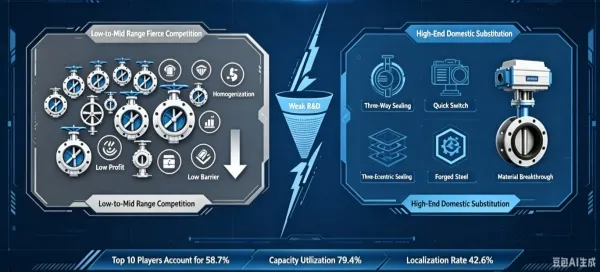
The Asia-Pacific region contributes 52.6% of global demand growth. Europe and North America achieve steady market recovery with compound annual growth rates of 4.1% and 3.7% respectively. While the overall market is growing steadily, the domestic industry presents a stark contrast. Conventional center-line soft-seal butterfly valves have low entry barriers. Numerous small-and medium-sized enterprises (clustered in Yongjia and Longwan of Wenzhou, and Cangzhou of Hebei) flood into this segment, resulting in severe product homogenization and intense price competition. In contrast, high-temperature & high-pressure, triple-eccentric and smart regulating butterfly valves are in short supply, and the market remains heavily reliant on imports.
Four Major Segments Drive Industry growth
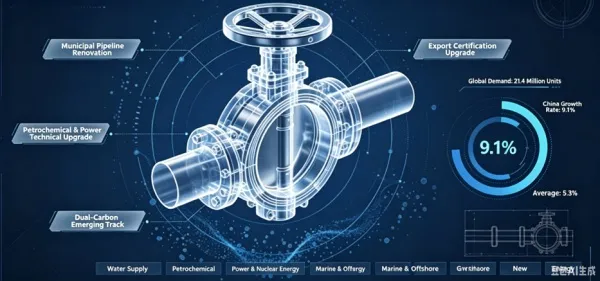
In terms of demand structure, global demand for butterfly valves is estimated at 21.4 million units in 2026. Municipal water services and building HVAC account for 37.5%, petrochemicals 28.9%, power and nuclear power 14.2%, and ship and offshore engineering 8.4%. The remaining demand comes from metallurgy, pharmaceutical, new-energy and other emerging fields. Domestic market demand rises by 9.1%, far higher than the global average of 5.3%, driven by four key growth pillars.
✅1. Municipal Pipeline Renovation Approximately 98 000 kilometers of aging urban pipelines are under renewal across China. National water network projects, sewage quality & efficiency improvement initiatives and smart water services boost the penetration of smart butterfly valves, generating steady demand for large-caliber double-eccentric and rubber-lined butterfly valves.
At present, bidding logic for water-sector projects has shifted. The chance of winning bids merely through low pricing keeps declining. Sealing performance, corrosion resistance and full-life-cycle cost have become key assessment indicators. Meanwhile, the penetration rate of smart electric butterfly valves in municipal projects is rising rapidly.
Conventional center-line butterfly valves for building HVAC show limited new-demand growth; market demand is dominated by stock replacement, and price competition remains fierce.
✅2. Traditional Industries: Decelerated New-Builds, Technical Retrofit Brings Triple-Eccentric Dividends Growth of new-construction projects in petrochemicals, conventional nuclear islands, seawater desalination, ships and offshore engineering is slowing down. Orders mainly come from technical retrofits of existing facilities, safety upgrades and zero-emission revamp projects.
Traditional center-line butterfly valves are in the late maturity stage, while high-performance triple-eccentric butterfly valves are in a rapid-growth phase with an annual growth rate of 12%-15%. Currently, the localization rate of domestic high-end butterfly valves is only 42.6%, which is expected to reach 61.5% by 2030, representing huge potential for domestic substitution.
Foreign high-end products currently carry a 2.3-fold price premium over equivalent domestic products, and the high-end segment delivers considerable profit margins.
✅3. New Dual-Carbon Track: Hydrogen Energy, LNG and CCUS Unlock Blue-Ocean Growth Amid the dual-carbon goals and Industry 4.0 wave, smart regulating butterfly valves and corrosion-resistant PTFE-lined butterfly valves have become core growth drivers. Their combined sales accounted for 41.3% of total sales in the first half of 2026.
Accelerated localization of LNG receiving terminals fuels strong demand for cryogenic-resistant butterfly valves. CCUS carbon-capture working conditions put forward brand-new requirements for highly corrosion-resistant butterfly valves. Special-purpose valves for hydrogen transportation and nuclear-fusion experimental reactors represent cutting-edge incremental markets for the industry.
However, these tracks feature extremely high entry barriers, with stringent requirements for special materials, sealing processes, working-condition verification and various qualification certifications. Ordinary small- and medium-sized manufacturers are not advised to enter these markets blindly.
✅4. Export Market: Shifting to Quality-Oriented Development plus Certified Overseas Expansion China’s full-industrial-chain advantages in the butterfly-valve industry continue to take effect. In 2025, China’s butterfly-valve exports reached USD 22.5 billion, while imports dropped to USD 8.2 billion, expanding the trade surplus to USD 14.3 billion.
Infrastructure demand remains robust in the Asia-Pacific and the Middle East, and market demand in Europe and America recovers steadily. Nevertheless, overseas market-entry thresholds have risen. Certifications including CE, API, fire-resistance and zero-leakage have become essential entry tickets. New European PFAS environmental regulations also create new trade barriers for PTFE-lined products.
Widening Divergence and Accelerated Industry Consolidation
Global butterfly-valve production capacity is concentrated in China, Italy, Germany, Japan and the United States. The world’s top-ten manufacturers jointly hold 58.7% of the market share. China’s domestic industry shows a distinct dual-pattern landscape: full-fledged competition in mid-to-low-end segments and oligopoly dominance in high-end markets. Industry capacity utilization rebounded to 79.4% in Q1 2026.
In the low-end general-purpose market, numerous small- and medium-sized enterprises crowd into the general-purpose butterfly-valve track, leading to overcapacity. Fluctuating raw-material prices force enterprises to keep cutting gross profit; gross profit margins of many factories have been squeezed to around 10%. With increasingly strict requirements for TS certification, type tests and environmental inspections, small- and medium-sized factories lacking R&D capacity and relying solely on price wars will face mounting survival pressure over the next five years.
By contrast, orders in the mid-to-high-end segment are flowing to enterprises with material R&D qualifications, in-house testing laboratories and high-tech enterprise credentials. Industry concentration keeps rising, and leading enterprises capture benefits from major projects. For the vast number of small- and medium-sized manufacturers, avoiding the red-ocean general-purpose market and targeting niche markets is the viable survival strategy.
For example, enterprises can achieve sound profits by focusing on seawater service conditions, ship supporting equipment, ventilation butterfly valves, specific media for fine chemical industry, and overseas niche regions. They can bypass the red-ocean competition for general-purpose products by adopting a “small-but-specialized, small-but-premium” development strategy.
Intelligence & Special-Purpose Sealing: Key to Building Competitive Edge
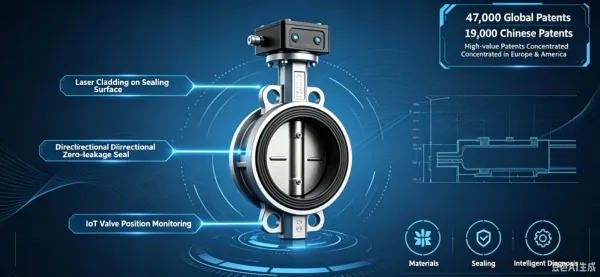
As of May 2026, there are 47 000 valid global butterfly-valve patents, among which 19 000 are held by China, accounting for 40.4%. Despite the considerable quantity, high-value core patents for key sealing materials and intelligent diagnosis algorithms are still owned by overseas companies, which constitutes a weakness of China’s domestic industry.
Three technical hotspots have emerged: laser cladding technology for sealing surfaces, bidirectional zero-leakage soft-hard composite sealing, and remote valve-position monitoring based on the Internet of Things. Relevant patent applications rose by 23.6% year-on-year.
Intelligence is no longer an optional bonus for the butterfly-valve industry but a mandatory requirement. The proportion of manual butterfly valves keeps declining. Electric and pneumatic smart butterfly valves equipped with opening feedback, torque monitoring and data interfaces are seeing rapid sales growth. Valves are gradually evolving from simple pipeline switches into sensing nodes of industrial systems.
From 2026 to 2030, the global butterfly valve market will register a compound annual growth rate of 4.8%, and its market size is projected to reach USD 236.6 billion by 2030. China’s industry will no longer depend on capacity expansion. Its core growth drivers are the dual engines of existing-equipment renewal and energy transition. Domestic substitution of high-end products serves as the main theme, while emerging dual-carbon-related tracks bring new market increments.
Enterprises in this industry can follow two development paths:
👉Large-scale leading enterprises: Tackle high-end application scenarios such as triple-eccentric service conditions, nuclear power, LNG, CCUS and hydrogen energy. Develop self-developed smart products, improve material and testing systems, seize the historical dividends brought by rising localization rates, and actively expand overseas markets.
👉Small- and medium-sized manufacturers: Break away from low-price-driven cut-throat competition and abandon homogenized rivalry for general-purpose products. Dig deep into niche working-condition segments, obtain all necessary bidding qualifications, upgrade products to complete electric and pneumatic assemblies, improve machining precision, and explore overseas niche markets relying on product certification credentials.
There will be no explosive growth for the butterfly-valve industry in the coming five years, yet tremendous changes will take place in market structure. Competition for general-purpose products will become increasingly fierce. Enterprises with technical barriers and niche advantages will secure better orders and profit returns. What the market eliminates is never basic manufacturing, but stagnant production models.
References
1. 2026 Global Butterfly Valve Market Research Brief
2. Industrial Survey & White Paper, Valve Branch of China General-Purpose Machinery Industry Association
3. Global Butterfly Valve Industry Research Reports by Frost & Sullivan, Technavio
4. Policy Documents on Urban Renewal and Dual-Carbon Goals issued by National Energy Administration and the State Council of the People’s Republic of China
5. Equipment Research Report, China Petroleum and Chemical Industry Federation
6. Patent Statistics from WIPO and China National Intellectual Property Administration
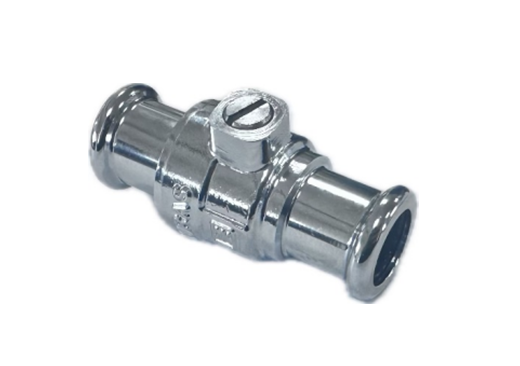
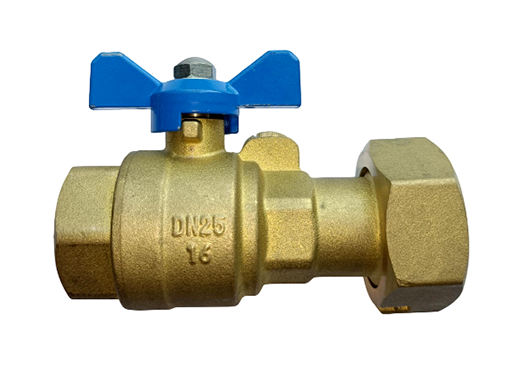
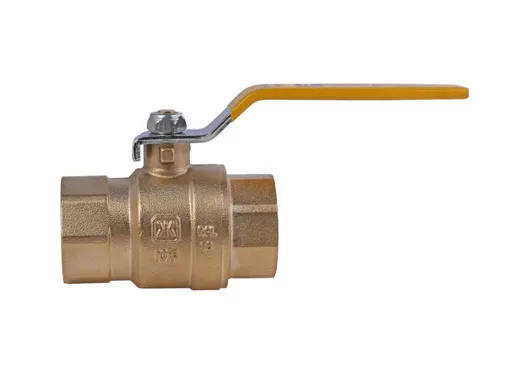
Other Brass Valves from JKL Brass Valve