As population density increases, the number of high-rise buildings in cities has grown significantly, leading to a substantial rise in the utilization rate of central air conditioning systems. This increased usage has, in turn, given rise to energy consumption concerns. This article provides a brief introduction to central air conditioning systems and offers a concise analysis of their cost.
In recent years, driven by rapid economic growth, cities have seen a steady increase in the number of high-rise buildings—including large clusters of office towers and extensive, high-end residential complexes. Alongside this growth in the number of such structures, the demand for air conditioning systems has also risen; consequently, the selection of appropriate air conditioning solutions has become a growing concern for many. Traditional air conditioning systems, which can negatively impact a building's aesthetic appearance and fail to meet user requirements in terms of energy efficiency, space utilization, or individual unit control, have gradually been phased out in large-scale or densely populated buildings. In contrast, central air conditioning systems, which offer superior advantages in both space utilization and energy efficiency compared to traditional systems, have gained widespread recognition from both users and the market.
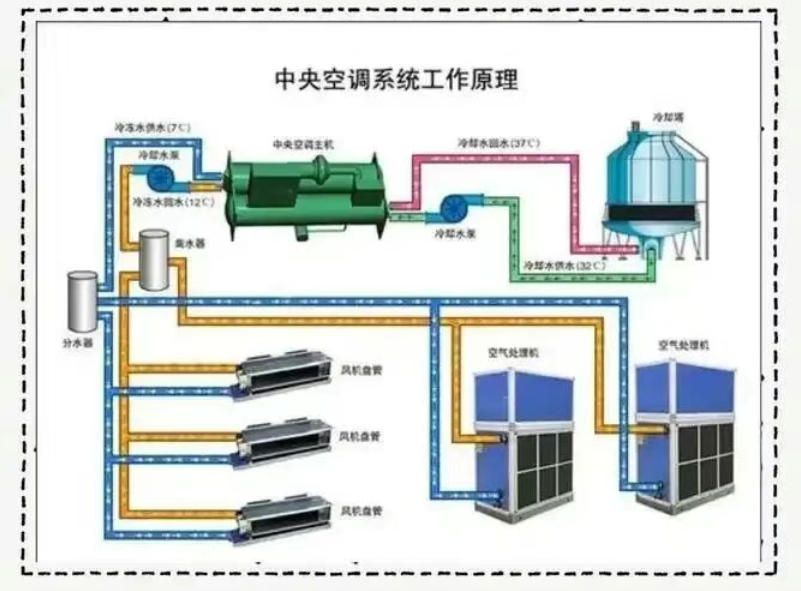
1 Central Air Conditioning System Composition and Classification
A central air conditioning system, as the name suggests, uses a central controller to regulate temperature and then distributes the required cooling or heating air to various locations via separate ductwork, thereby achieving air conditioning objectives. Depending on its specific application scope, central air conditioning systems are further classified into large-scale central air conditioning systems and residential central air conditioning systems. Compared to large-scale systems, residential central air conditioning systems typically consume relatively lower power; however, the numerous advantages of large-scale systems are equally applicable to residential systems as well. Currently, these systems are widely used in residential, industrial, and commercial settings. The composition of a central air conditioning system is essentially identical to that of a traditional air conditioning system; its primary components include the cooling and heating systems, as well as other components required for installation.
Depending on the type of air conditioning system and the underlying refrigeration principles, central air conditioning systems primarily include water-based central air conditioning systems, air-based central air conditioning systems, and coil-based central air conditioning systems.
(1) In the water-based central air conditioning system, cooling water plays the dominant role; the reduction in temperature is achieved through the circulation of this cooling water. Once the air temperature has been lowered, the cooled air is delivered through other pipelines. This system consists primarily of four components: first, a compressor that drives the refrigerant's compression – a critical component of the air conditioning system; second, a condenser, another essential component, which processes and condenses the compressed gas; after being processed by the condenser, the air passes through a further device known as a throttling device, which further treats the condensed gas to produce a low-temperature, low-pressure liquid; finally, after being processed by an evaporator, the cooled air is discharged from the pipelines through additional equipment to meet the users' needs.
(2) Air-handling system for central air conditioning: This system involves directly passing air through dust removal and purification processes, then adjusting its temperature—either increasing or decreasing it—and subsequently distributing the conditioned air to various zones via ductwork, tailored to the specific requirements of the occupants. During this distribution process, air circulates within the indoor space, including the exhaust air expelled by occupants; therefore, a circulation system is required to facilitate this air exchange and maintain indoor air circulation. The air-handling system for central air conditioning achieves indoor air purification by exchanging fresh air with exhaust air, thereby effectively regulating the indoor environment.
(3) Fan Coil Air Conditioning System. As the name suggests, the "coil" refers to a coil-shaped piping component. The system typically consists of a fan, a coil, a filtration system, and an air outlet, among other components. In an air conditioning system, the coil's function is to first draw air in using the fan, and then utilize its unique geometry to achieve continuous air recirculation. Subsequently, the air is heated or cooled within the coil, thereby altering its temperature and humidity levels within the system. This heating or cooling process is accomplished using cold or hot water circulating through the associated piping. After undergoing this series of treatment processes, the conditioned air is distributed via various ducts to different zones to meet the requirements of the indoor environment.
2 Central Air Conditioning System Cost Analysis
In recent years, with social progress and technological advancements, central air conditioning systems have been widely adopted in everyday life; however, this has given rise to the issue of their energy consumption.
As mentioned earlier, a central air conditioning system consists primarily of an air compressor, condenser, evaporator, cooling system, and fans. When designing and installing a central air conditioning system, it is essential to account for the maximum load that the system can withstand. This means that the compressor unit, fan system, and other circulation systems within the air conditioning system must be designed and installed to handle the maximum load. However, in actual operation, the utilization rate of the air conditioning system often does not meet the design specifications; typically, the operating load is only between 50% and 70% of the system's design capacity—far below the standard design capacity requirements. According to statistics, the electricity consumption of central air conditioning systems accounts for more than 70% of the total electricity consumption of all indoor electrical equipment; therefore, a cost analysis of central air conditioning systems is particularly important. Such a cost analysis can be conducted from the following perspectives: first, the overall air conditioning system—comprising the main unit and other accessories, including the distribution network, fans, and so on; second, the operating costs incurred once the system is installed and in service; third, the maintenance costs required for the air conditioning units during their operational life, which also constitute an integral part of the total system cost; and finally, any special air conditioning equipment that may require manual maintenance, the associated costs of which should also be included in the air conditioning cost analysis.
2.1 Central Air Conditioning System Installation Cost
Different types of central air conditioning systems vary in cost depending on their power consumption and application scope; this cost difference primarily stems from the system configuration. Depending on the user's requirements, the composition of a central air conditioning system should be adjusted accordingly – a variation that is mainly driven by the differing power ratings of the units. For example, compared to large-scale central air conditioning systems, residential central air conditioning systems are typically used in smaller spaces and require lower power consumption. As a result, when designing and installing such systems, the power ratings for the compressor unit and other circulation components can be appropriately reduced, which lowers the installation cost of the entire system. Furthermore, reducing the system's power rating helps lower operating costs over time, as lower power consumption translates to reduced energy consumption and maintenance expenses.
Therefore, when installing an air conditioning system, it is advisable to select an air conditioning unit with an appropriate power rating based on the environmental conditions and operational requirements, thereby reducing both installation and operating costs.
2.2 Equipment Operating Costs
After the air conditioning system is installed, it is necessary to calculate and analyze its operating costs. These operating and usage costs primarily consist of electricity expenses and other system-related costs. Similarly, these costs are closely correlated with the air conditioning system's output capacity. Taking large-scale central air conditioning systems as an example – which are typically deployed in large buildings – the electricity consumption during operation is significantly higher than that of residential air conditioning units; likewise, the operating costs for other associated systems are also higher than those for residential air conditioning units. Therefore, to reduce air conditioning operating costs, it is advisable to appropriately adjust the load on the air conditioning system to lower both energy consumption and operating expenses.
2.3 Equipment Maintenance Costs
After the equipment installation is completed, maintenance should be performed on the equipment. For example, in central air conditioning systems that include chillers, the indoor filters should be cleaned regularly, and the ductwork within the air conditioning system should also be cleaned periodically. However, the types of maintenance required vary depending on the specific air conditioning system; for instance, multi-split central air conditioning systems entail significantly lower maintenance costs compared to conventional air conditioning systems – these costs are virtually negligible.
2.4 Equipment Management Costs
The management costs associated with equipment primarily arise because certain air conditioning units may require specific floor space during operation; consequently, dedicated areas must be designated for the proper placement of such equipment. Additionally, some units may generate significant operating currents that could affect other electrical equipment; therefore, these units require personnel supervision during operation. These factors contribute to the occurrence of equipment management costs.
Overall, the cost of central air conditioning systems primarily comprises the four components mentioned above; to reduce the total cost of such systems, one can consider the specific operating environment and opt for air conditioning systems with lower management and maintenance costs.
3 Conclusion
As population density increases in the future, the number of high-rise buildings will grow significantly, and the application prospects for central air conditioning systems will be exceptionally broad. However, greater attention should be paid to energy efficiency during their operation; therefore, when designing and installing air conditioning systems, the intended application scope should be thoroughly considered, energy-efficient air conditioning units should be selected, the operational load on these systems should be minimized, and energy consumption should be reduced. As the use of air conditioning systems becomes increasingly widespread, reducing construction costs and overall operating expenses will represent important challenges that need to be addressed in the future deployment of these systems.
NEXT
Other Brass Valves from JKL Brass Valve