
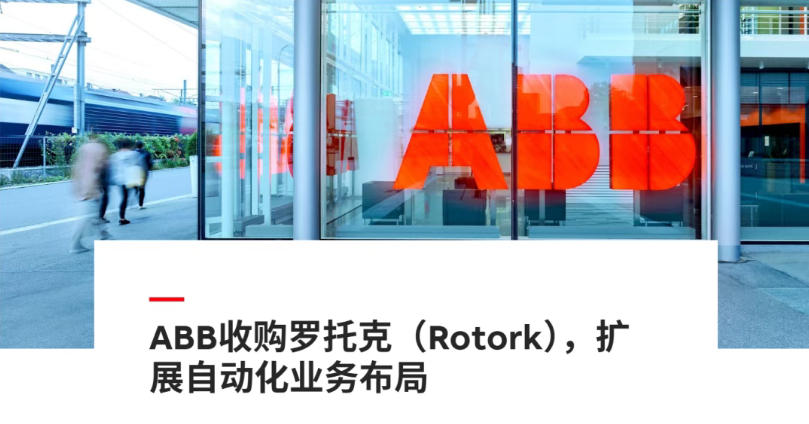
In mid-July, a piece of news made waves within the industrial sector: ABB announced the acquisition of UK-based Rotork for US$5.5 billion in cash – representing a premium of nearly 60%, which corresponds to an EV/EBITDA multiple of 19.5 times for 2025 – or 15 times even when synergies are factored in.
Many people might first wonder: Didn't ABB just sell its robotics business to SoftBank for US$537.5 million? How could it then use that money to buy a company that makes valve actuators?
On paper, the numbers do seem a bit confusing: the sold robotics business generated approximately US$2.3 billion in revenue in 2024, whereas the acquired Rotork business is expected to generate only about US$1 billion in revenue in 2025; yet the latter boasts a profit margin of 24.6% and an average annual organic revenue growth rate of 8% from 2022 to 2025. Essentially, it's like replacing a larger, less profitable business unit with a larger but more lucrative one – what's ABB trying to achieve with this move?
If one only reads up to the "Execution (Act)" segment of the closed-loop automation system, they would be underestimating this transaction. When viewed within the broader context of industrial automation over the next five to ten years, Rotork is actually a strategic move by ABB toward "software-defined field device layer."
First, let's clear up a misconception: Rotek is no longer just a "pure machinery manufacturer."
When mentioning Rotork, the first reaction in the industry is often "the UK-based, established actuator giant founded in 1957, and a standard valve component in the oil, gas, and water utilities sector." This impression is accurate, but it reflects the situation from five years ago.
If you look at its performance over the past three years:
In 2021, iAM (Intelligent Asset Management) – a cloud-based asset management system – was launched, aiming to reduce unplanned downtime.
The IQ3 Pro was launched in 2023 – simply pair it with your smartphone via Bluetooth to configure and control the actuator, with all data automatically sent to the cloud.
The actuator itself now supports "Full Lifecycle Management" and "Reliability Tiered Service".
In other words, although Rotork sells "motors for operating valves," the company itself is already transforming its actuators into edge nodes – it has long had a clear plan for how to transmit field data—such as valve position, torque, temperature, and switching frequency—to the cloud.
This is a critical point. ABB is not merely interested in its annual US$1 billion in revenue and 24.6% profit margin; rather, it is particularly interested in its existing equipment deployed in the "last mile" of process industries—namely oil and gas, water utilities, chemicals, and power generation. These industries are characterized by slow digital transformation, long equipment replacement cycles, and strong customer loyalty—yet they represent the exact domain where "real-world operational data" is most scarce for AI-driven industrial applications.
Three sectors of industrial automation are currently experiencing a decline
The combination of ABB and Rotork provides a clear lens through which to observe three key developments in industrial automation – each of which is far more intriguing than merely "closing the loop."
① The Control Pyramid is "collapsing" – ISA-95 has been rewritten
The classic reference for traditional industrial automation is ISA-95, which follows a hierarchical pyramid structure spanning from field devices → control systems → production management → enterprise level. However, ABB's latest Automation Extended strategy explicitly states that it aims to separate "stable process control" from "digital capabilities": the core control system remains unchanged, while higher-level capabilities are built upon using software and edge computing – without having to rebuild everything from scratch.
What is the role of Rotork? It is one of the most formidable players within the "Field Device Layer" —the base layer of the pyramid. While ABB's original automation portfolio included the DCS (System 800xA), frequency converters, and motors, the Field Device Layer—where devices directly interact with valves and fluids—had always been a weak point. By integrating Rotork, ABB has finally fully closed the "Sense–Control–Act" closed-loop system, a concept that ABB has repeatedly emphasized.
However, the deeper implication is that once the closed-loop system is fully implemented, the data flow no longer needs to undergo "multi-layered reporting." Actuators can perform local decision-making, the edge can handle preprocessing, and the cloud can run AI models.
② The actuator is evolving into an "edge computing node".
In the past, engineers had a simple expectation for actuators: upon receiving a 4–20 mA signal, they simply needed to rotate the actuator accordingly.
The future isn't like this anymore. Rotek's IQ3 Pro can already do it –
Mobile app for on-site debugging (no need to open the explosion-proof cover – a critical requirement for petrochemical plants)
Automated data log upload to iAM Cloud
Local recording of torque curve, switching frequency, and ambient temperature for life-cycle estimation
ABB has integrated this solution into its Ability Platform (an Edge+Cloud architecture built on Azure, currently managing 70 million connected devices and 70,000 existing control systems), combined with the Ability Genix Industrial AI Suite (which claims to reduce O&M costs by 40% and increase production efficiency by 30%) – and you'll discover a clear path forward:
The next round of industrial AI competition won't be about which PLC runs faster – it will be about which company can integrate the "last inch" of field data into its own training闭环.
The US$1 billion in revenue generated by Rotork stems from decades of expertise in oil and gas wellhead systems, water distribution networks, and chemical pipelines – data scenarios that ABB is not uniquely positioned to generate on its own, but that Rotork possesses, and that Rotork itself has already embarked on digital transformation. This is the real driver behind its 19.5x EBITDA multiple.
③ "Software-Defined Automation": From slogan to implementation – on-site equipment is the final piece of the puzzle.
Schneider Electric is promoting EAE, Siemens is advocating "Software-Defined Everything," and Red Hat is leveraging OpenShift + Real-Time Linux to containerize software-based PLCs and DCS systems – an industry consensus has largely taken shape: the traditional architecture, where hardware is tightly bound to software, can no longer support flexible manufacturing or the integration of AI; software-defined approaches will serve as the foundation for the next decade.
However, there's an often-overlooked detail: the parts of the system that are easiest to modify in a software-defined architecture are the "middle-layer" systems—such as PLCs, DCSs, and SCADA systems—while the field device layer is the most challenging to modify. This is because field devices—such as valve actuators and sensors—typically have a lifecycle spanning up to 15 years; their communication protocols are proprietary, and they cannot be replaced or modified.
The hidden value that ABB has identified in Rotork lies precisely here: while Rotork continues to operate as an independent business unit, its digital capabilities—such as the IQ3 Pro and iAM—can be integrated into ABB Ability ahead of time. This effectively allows ABB to quietly establish a strategic foothold within the "most challenging software-defined field layer" that aligns with its own ecosystem. When SDA (Software-Defined Automation) is truly deployed on a large scale, ABB will possess both an intermediate layer (800xA, Symphony Plus, Freelance) and a field layer that is already "software-ready."
Back to the $5.5 billion: What strategic moves is ABB making?
Put several events together to view them:
Selling robots to SoftBank (¥5.375 billion) → Exiting the highly competitive red ocean – the discrete manufacturing sector, where the intensity of the Asian price wars is at its peak.
Acquisition of Toko (€5.5 billion) → Strengthening focus on the field-layer segment of the process industry – characterized by high margins, strong customer stickiness, and strong demand-side attributes
Approximately US$14 billion remains available for further M&A activities → It is clear that the acquisitions have not yet been fully completed.
ABB's dual strategy of "Electrification + Automation" is now clearer than ever: in the discrete manufacturing sector, where it couldn't compete with Asian manufacturers, the company simply exited that market; in the process industry sector, where it boasts vast data assets, high gross margins, and where digital transformation is still in its early stages, the company has made a substantial bet.
The reason behind Rotork's CEO receiving a 60% premium, or the reason why ABB shareholders are willing to pay a 19.5 times EBITDA multiple – neither is tied to that US$1 billion in revenue; rather, it lies in the "small piece of land adjacent to the' valves'" that will gradually evolve over the next five years into asset nodes for edge computing and AI.
Epilogue: The "Last Inch" War in Industrial Automation
Looking back at this acquisition, it serves more as a signal: Industry 4.0 has been discussed for over a decade, and every layer—sensors, PLCs, DCSs, MES, and ERP—has already undergone a wave of transformation. The next most valuable battleground lies in the final "inch" of the field equipment layer—those "heavier but critical" devices: valves, actuators, pumps, compressors, and so on. Whoever can first software-enable these devices, connect them to the internet, and feed them to AI will secure the gateway to the process industry's next decade.
ABB spent €5.5 billion to acquire a stake. Rotek's time-honored slogan, "Mission-Critical Intelligent Flow Control," now carries an additional layer of meaning compared to before the acquisition.
The next time you hear about an automation giant partnering with a seemingly "traditional" on-site equipment manufacturer, don't rush to calculate its sales-to-market ratio – instead, take a closer look at which segment of the supply chain, what type of medium, or the "last inch" of the industry it's involved in.
Reference materials: ABB official announcements, Weike Network – Intelligent Manufacturing, ABB Ability Platform Architecture, Rotork Product Evolution, and industry analysis related to Software-Defined Automation.
Other Brass Valves from JKL Brass Valve