As a colleague involved in valve sales and technical support, over the past two years while reviewing bid documents, I've increasingly come across the following terms:
API 624、ISO 15848、TA-Luft,
This is often accompanied by the statement: "The bid-winning product must be accompanied by a Low Leakage Certification Certificate."
Ask the technical team – and they might ask you back:
"What does 'low leakage' mean? Our valves passed the factory pressure test without any leakage."
The problem lies precisely here: "pressure test for no leakage" and "low-leakage certification" are two distinct concepts. This article clarifies three key points: what exactly is measured during a low-leakage test, what each of the four standards applies to, and how to respond when submitting a bid.
01 Low-leakage measurement detects "external leakage," not a loose seal.
First, let's clarify the most frequently misunderstood concept: "low leakage" in valves (also known as fugitive emissions) does not refer to internal leakage—where the medium leaks from the valve seat to the downstream side due to the valve not being tightly closed. Instead, it refers to external leakage—the minute amount of gas that escapes directly into the atmosphere through the valve stem packing box or at the junction between the valve body and the valve cover.
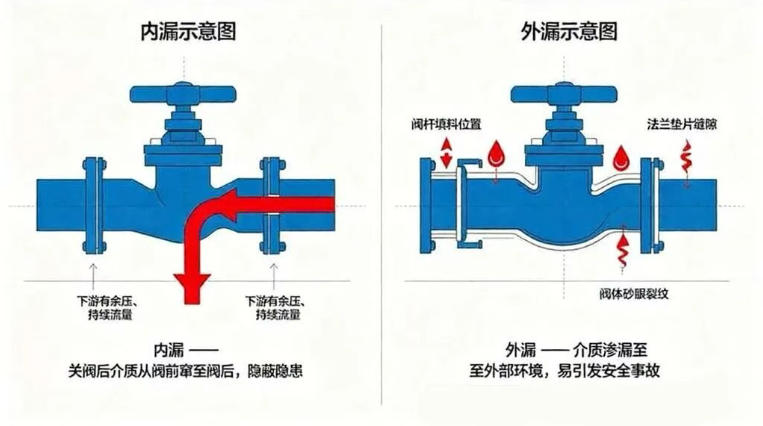
Internal leaks involve products; external leaks concern safety and environmental protection. The media flowing through petrochemical and coal chemical processing units often consist of VOCs (volatile organic compounds), toxic gases, or flammable gases – which seep out gradually through the gaps in valve stems; these leaks are invisible to the naked eye, but they can be detected through environmental monitoring and safety inspections. As a result, in today's high-end projects, obtaining a Low-Leakage Certification has been incorporated as an entry requirement into bidding documents, particularly for industries where VOC emissions are subject to stringent control measures.
02: What does each of the four standards cover?
The common low-leakage standards specified in bidding documents primarily consist of four types. These standards differ in their applicable objects, measurement methods, and acceptance criteria; selecting the wrong standard will render the bid invalid.
standard | Which valve should be used? | What to measure? | Acceptance Criteria |
API 624 (first published in 2014) | Open-face gate valve, shut-off valve | 310 mechanical cycles + 3 thermal cycles (up to 260°C), ≤100 ppmv methane | Pass/Fail |
API 641 (first published in 2016) | Quarter-turn valve: ball valve, butterfly valve, plug valve | 610 mechanical cycles + 3 thermal cycles (up to 260°C), ≤100 ppmv methane | Pass/Fail |
ISO 15848-1/2(2015+A1:2017) | Isolation Valve + Control Valve (Universal) | Helium or methane – classified according to a three-dimensional grading system based on sealing, durability, and temperature. | Tiering (AH/BH/CH, AM/BM/CM) |
TA-Luft 2021 | Valve stem sealing system | Only a permissible leakage limit is defined; no classification system is implemented. | Limit value (depends on pressure and temperature) |
▲ First, let's look at the API standard. (Image sourced from the internet; for reference only.)
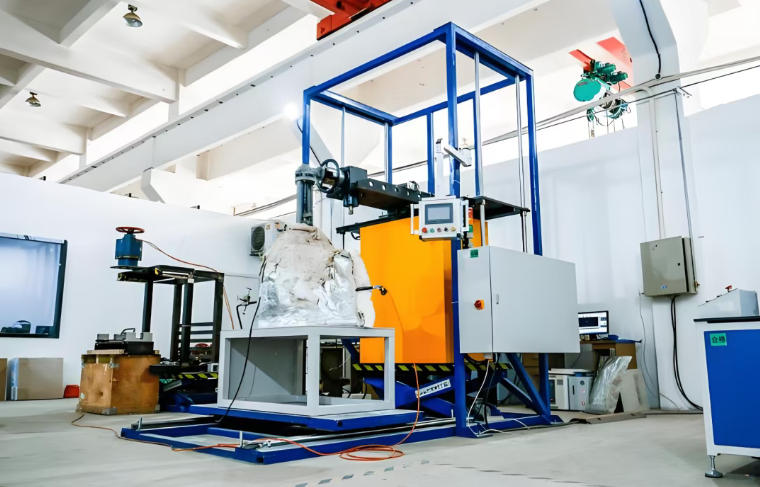
The API 624 nominal-gauge gate and globe valves, introduced in 2014, require the entire valve to undergo 310 mechanical cycles plus 3 thermal cycles. The test medium is methane with a purity of no less than 97%; at no measurement point during the entire test shall the leakage exceed 100 ppmv; and no adjustments to the packing system are permitted during the test. One common oversight is that API 624 mandates the use of flexible graphite packing certified under API 622 – whereas API 622 only tests the packing itself, while API 624 tests the entire valve equipped with such packing; both steps are mandatory. The API 641 quarter-turn valve (ball valve, butterfly valve, or plug valve), introduced in 2016, requires 610 mechanical cycles plus 3 thermal cycles, using methane at ≤100 ppmv. ▲ The ISO 15848-1 standard follows a different approach: instead of simply determining whether a valve passes the test or not, it employs a tiered evaluation system.
The test medium may be helium (for more stringent applications) or methane; it is classified into three levels based on the valve stem sealing leakage rate:
Test medium | Strictest | secondary | basic |
Methane (ppmv) | AM ≤ 50 | BM ≤ 100 | CM ≤ 500 |
Helium (unit: mbar·L/(s·mm)) | AH ≤ 1.78×10⁻⁷ | BH ≤ 1.78×10⁻⁶ | CH ≤ 1.78×10⁻⁴ |
In terms of sealing configurations, generally: bellows seals or equivalent designs can achieve AH/AM (most stringent); PTFE or rubber ring seals can achieve BH/BM; flexible graphite packing typically corresponds to CH/CM. This is why, in high-end projects requiring minimal leakage, bellows seals are often specifically specified.
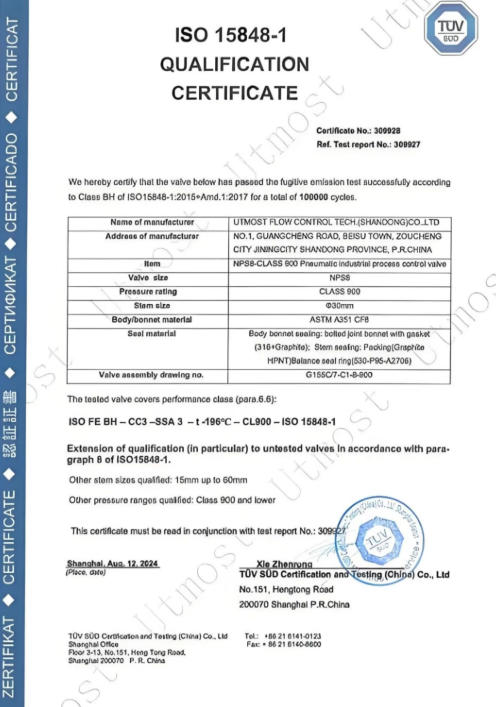
In addition to the aforementioned classification system, ISO 15848-1 incorporates two additional dimensions: durability rating (for isolation valves: CO1 = 205 cycles, CO2 = 1500 cycles, CO3 = 2500 cycles; for control valves: CC1 = 20,000 cycles, CC2 = 60,000 cycles, CC3 = 100,000 cycles) and temperature rating.
(Temperature range: from-196°C to +400°C in incremental steps). Therefore, an ISO 15848-1 certificate must fully specify the "Sealing Class + Durability Class + Temperature Class"; simply stating "Class A" is insufficient. Both valves may be classified as "Class A," but their number of cycles and temperature ranges can vary significantly. (Image sourced from the internet; for reference only.)
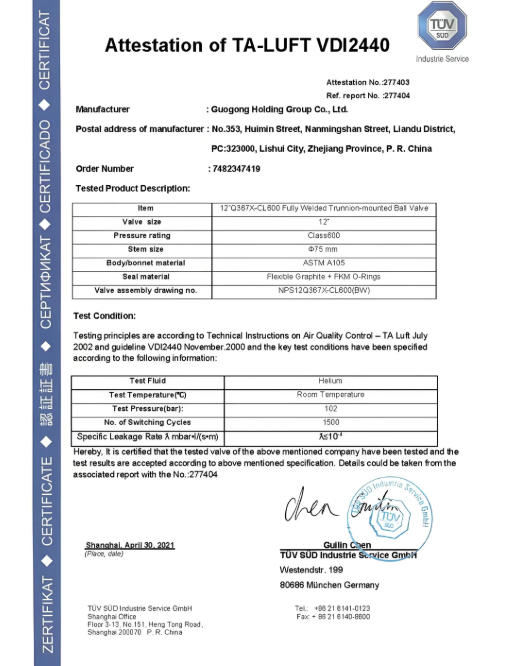
▲TA-Luft is the German Technical Guide for Air Quality Control, first published in 1964; its 2021 revised edition aligns its testing methods with ISO 15848-1. (Image sourced from the internet, for reference only.) Its most significant difference from the previous three standards is that it specifies a single allowable leakage limit without employing a classification system; furthermore, this limit varies depending on operating pressure and temperature. It is primarily used in Germany and certain European projects and is a mandatory regulatory requirement, not merely a commercial choice.
03 Three key figures – the most frequently asked questions during the bidding process
If you only need to remember three numbers, just remember these three:
◆ Mechanical circulation cycles:
API 624 corresponds to 310 cycles; API 641 corresponds to 610 cycles;
The ISO isolation valve operates between 205 and 2,500 cycles; the control valve operates between 20,000 and 100,000 cycles.
The higher the cyclic number, the closer it is to the actual operating conditions.
◆Leakage Limit:
API pathway: ≤100 ppmv methane;
ISO Methane Path: AM ≤ 50, BM ≤ 100, CM ≤ 500 ppmv;
Helium flow path: AH ≤ 1.78 × 10⁻⁷ mbar·L/(s·mm).
◆temperature range:
API 624 – Maximum operating temperature: 260°C;
ISO covers a temperature range from-196°C to +400°C.
There is an important unit issue to note: the API specifies concentration in ppmv, whereas the ISO helium flow rate is expressed in mbar·L/(s·mm) (flow rate per millimeter of valve stem diameter); these two units cannot be directly converted into one another. Therefore, do not state in your tender documentation: "Our 100 ppmv corresponds to your required AH grade" – this does not represent a valid dimensional relationship.
04 Three Practical Implementation Paths (Recommended: Save screenshots)
For integration into Sinopec or PetroChina systems: use API 624 for API gate and globe valves, and API 641 for ball and butterfly valves – provided that packing certified according to API 622 is available. This approach is the most straightforward and enjoys high acceptance within the domestic market.
️
EU/Shell/Internationalization Project: Comply with ISO 15848-1 and provide full specifications – for example, "BH-CO₂ at 200°C"; clearly indicate the sealing, durability, and temperature classes – do not simply use "Class B".
️
German and European regulatory compliance program: Look at TA-Luft – it adheres to local regulations, with limit values adjusted according to operating conditions; it's not a one-size-fits-all solution based on a single certificate.
When Party A asks about "low leakage" during the bidding process, you can respond as follows:
Scenario 1: The tender document only mentions "low-leakage certification" without specifying which standard it refers to.
Reply: We provide an API 624/ISO 15848-1 low-leakage type test report, which includes the number of cycle tests, the leakage limit, and the test medium, fully complying with your technical requirements. Please don't assume – kindly ask whether your project is subject to acceptance according to which standard.
Scenario 2: Client asks whether API 624 and ISO 15848 can be used interchangeably?
Response: The applicable scope and acceptance criteria for the two standards differ; API 624 applies to exposed-valve systems and is based on a pass/fail acceptance criterion, whereas ISO 15848-1 is based on sealing, durability, or temperature classifications and covers both isolation valves and control valves. It is recommended to adhere to the standard specified by your design institute.
Scenario 3: Party A requests TA-Luft, but you do not have a certificate.
Answer: TA-Luft is a German regulatory requirement; its testing methodology aligns with ISO 15848-1. Our existing ISO 15848-1 certification report can serve as the technical basis. If TA-Luft certification is required, type testing may be arranged separately.
In short: Low-Leakage Certification, like SIL, is not a form of scientific research but rather a tool for bidding purposes. First, determine whether the client requires an API certification, an ISO certification, or a TA-Luft certification, and then apply the appropriate certification accordingly – don't simply take a pressure test compliance certificate and then claim it as a "Low-Leakage" certification.
This document is based on the following standards: API 624 (2014), API 641 (2016), API 622, ISO 15848-1:2015/A1:2017, ISO 15848-2:2015, and TA-Luft 2021.
PREV
Other Brass Valves from JKL Brass Valve