
Article Introduction
After the release and implementation of the new national standard (GB 5749-2022), two odor and taste indicators, namely 2-Methylisoborneol (2-MIB) and Geosmin, have become mandatory indicators, which has brought great challenges to many technical staff operating water plants. How to correctly understand and reasonably address odor and taste issues in drinking water? The "Water Industry Frontline" column of Water Purification Technology summarizes theoretical research and engineering practices from various sources to help you fully understand and tackle odor and taste problems in drinking water.
Primary T&O Compounds and their Characteristics of Domestic Drinking Water
01 What are Odor and Taste Compounds in Drinking Water?
Compounds causing odor and taste problems in drinking water come from complex sources, including natural substances, artificial chemicals, and a large number of unidentified substances. The Drinking Water Taste & Odor Wheel (T&O Wheel) classifies odors and tastes into 3 categories with 13 sub-types: 4 taste off-notes, 1 nasal-oral sensory abnormality, and 8 olfactory off-notes. Representative types include earthy-musty odor, fishy odor, chemical odor, chlorine odor, medicinal odor, aromatic odor, putrid odor, and grassy odor. Substances triggering odor and taste issues in drinking water can emerge at every stage of the water supply system from source water to household taps.
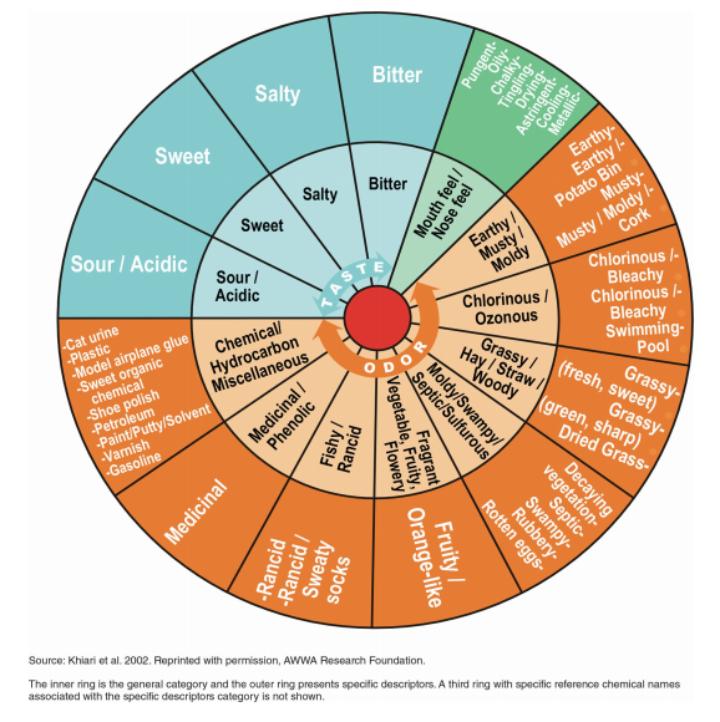
Figure: Drinking Water T&O Wheel
02 Where Do Odor and Taste Problems Occur From Source Water to Household Taps?
In source water, metabolites of algae and actinomycetes represented by 2-MIB and geosmin generate aromatic, fishy, grassy and earthy-musty odors. Biological degradation of sediment and decaying algae triggered by source water pollution produces sulfur-containing and nitrogen-containing compounds with unpleasant odors. Industrial wastewater discharge introduces phenolic compounds, methyl tert-butyl ether (MTBE) and other chemicals that also induce off-odors.
During water production at water plants, chlorine-based disinfectants added during treatment generate hypochlorous acid, monochloramine, dichloramine, trichloramine and other substances, which can be perceived by users once exceeding specific odor thresholds or taste thresholds. Ozonation processes produce pre-ozone and heptanal, causing ozone-like odors. Some water treatment chemicals may form chlorophenols and bromophenols, bringing medicinal odor to finished drinking water.
In the water distribution stage, microbial growth and metabolism in pipe sediments generates putrid odor. Residual chlorine continuously exerts disinfection effects during pipeline transportation, producing chlorine odor, medicinal odor and disinfection byproducts with offensive odors. Water supply pipeline materials containing organic ammonia, aldehydes, halophenols and other substances may also lead to odor and taste defects.
03 Characteristics of Odor and Taste in Drinking Water in China
Existing studies have identified 24 normally non-dominant algal species capable of producing 2-MIB, including Oscillatoria, Pseudanabaena, Planktothrix, etc. Most 2-MIB exists as extracellular dissolved matter. Geosmin originates from 22 odor-producing algal genera, among which Dolichospermum of Nostocales is the most representative, and geosmin mainly exists as intracellular substances.
References
[1] Yu Jianwei. Odor and Taste in Drinking Water: Sources and Control[R]. Huzhou: Special Seminar on Solutions to Odor and Taste Problems in Water Plants under the New National Standard, 2023.
[2] Liu Hongyuan. Discussion on Engineering Technical Measures for Off-Odors and Off-Tastes in Drinking Water[R]. Huzhou: Special Seminar on Solutions to Odor and Taste Problems in Water Plants under the New National Standard, 2023.
Other Brass Valves from JKL Brass Valve