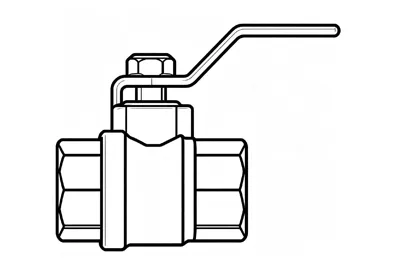
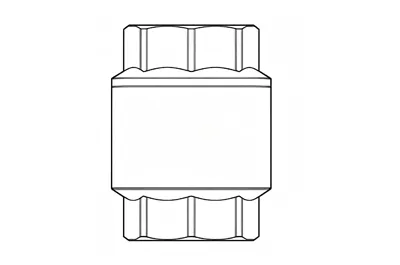
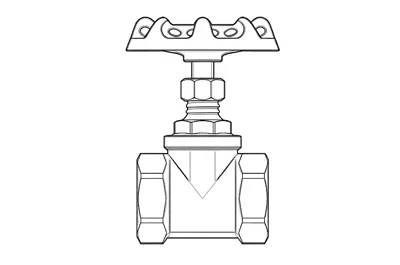
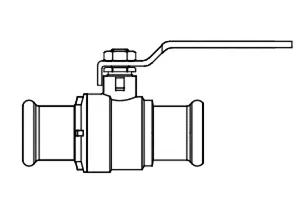
For applications requiring tight shutoff, low pressure loss, full-bore flow, or higher-pressure service, a ball valve is usually the better choice. For large-diameter pipelines where installation space, weight, throttling capability, and overall cost are priorities, a butterfly valve often provides greater value.
The right choice between a ball valve and butterfly valve should ultimately be based on operating pressure, temperature, pipe diameter, fluid characteristics, flow-control requirements, connection type, and required leakage performance—not simply valve price.
Ball Valve vs Butterfly Valve: Key Differences
Both designs are quarter-turn valves, but their internal structures create significant differences in operating performance.
| Comparison | Ball Valve | Butterfly Valve |
|---|---|---|
| Closure element | Rotating ball with a bore | Rotating disc |
| Shutoff performance | Excellent, especially for isolation | Good; depends strongly on seat and valve design |
| Flow restriction | Very low with full-port design | Disc remains in the flow path |
| Throttling | Generally not preferred with standard ball valves | Better suited to regulation |
| Pipe size | Common in small and medium lines | Highly practical for medium and large lines |
| Installation space | More body length and weight at large sizes | Compact and lightweight |
| High-pressure service | Generally stronger | Depends heavily on butterfly valve design |
| Large-size cost | Usually higher | Usually more economical |
Full-port ball valves can provide a nearly unobstructed flow path, while the disc of a conventional butterfly valve remains inside the pipeline even when fully open. Butterfly valves, however, become particularly attractive as pipeline diameter increases because of their compact face-to-face dimensions and lower weight.
Which Is Better: a Ball Valve or Butterfly Valve?
Neither valve is better for every application.
Choose a ball valve when the system requires:
Reliable tight shutoff
Low pressure drop
Full-port flow
Frequent on/off operation
Higher operating pressure
Gas or process isolation where leakage control is critical
Choose a butterfly valve when the project requires:
Large pipeline diameters
Compact installation
Lower valve weight
Moderate flow regulation
Reduced equipment and installation cost
Water supply, HVAC, cooling water, or similar utility service
For example, JKL's brass ball valve range includes products designed for water and gas applications, while its iron butterfly valve range includes wafer and flanged designs up to DN600 for water-service pipelines.
Which Valve Has Less Pressure Drop?
A full-port ball valve normally produces less pressure drop.
When fully open, the ball bore can align closely with the pipe diameter, creating a relatively straight flow path. This is particularly valuable in pumping systems where unnecessary resistance increases energy consumption.
In a butterfly valve, the disc and shaft remain within the flow path. Even at the fully open position, they create some obstruction and turbulence.
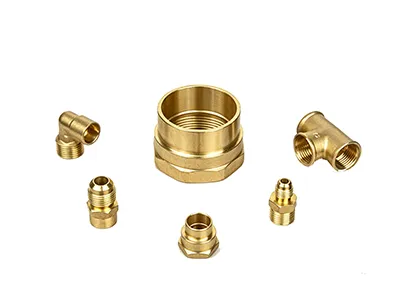
When specifying a complete ball valve system, however, engineers should evaluate more than the valve alone. Pipe diameter, reducers, elbows, ball valve fittings, strainers, and other components can also affect total system pressure loss.
Can Butterfly Valves Be Used for Flow Control?
Yes. Butterfly valves are widely used for throttling and moderate flow regulation.
The disc angle can be adjusted between fully open and fully closed positions, allowing operators or actuators to change flow rate. This makes butterfly valves useful in HVAC, cooling-water, water-treatment, and other utility systems.
Standard ball valves are primarily isolation devices. Keeping a conventional ball valve partially open for extended periods may expose the seat and ball edges to high-velocity flow, potentially increasing wear. Specialized control ball valves can be selected when more precise regulation is required.
When Should You Use a Butterfly Valve Instead of a Ball Valve?
Pipeline diameter is often one of the deciding factors.
As valve size increases, a ball valve becomes heavier and more expensive because of the larger body, ball, seats, and actuator requirements. Butterfly valves use a much thinner body and disc construction, making them particularly competitive in large-diameter installations.
Butterfly valves are therefore commonly considered for:
Water distribution
HVAC systems
Cooling and chilled-water systems
Fire-water systems
Irrigation
Industrial utility piping
Material also matters. Although industrial large-diameter butterfly valves commonly use ductile iron, stainless steel, or carbon steel construction, a brass butterfly valve is available for certain smaller threaded HVAC, water, air, and heating/cooling applications. Its suitability still depends on pressure, temperature, medium compatibility, and applicable certifications.
How Do You Choose Between a Ball Valve and a Butterfly Valve?
Before requesting a quotation, specify these six operating parameters.
1. Media
Identify whether the valve will handle water, gas, steam, oil, chemicals, compressed air, or another medium. Body, disc or ball, seat, seal, and stem materials must all be compatible.
2. Working Pressure and Temperature
Never select a valve based only on nominal pipe diameter. Confirm both the maximum operating pressure and temperature, including possible transient conditions.
3. Valve Function
For simple isolation, ball valves provide excellent shutoff performance. For larger pipelines requiring regulation as well as isolation, butterfly valves are often more practical.
4. Pipeline Size
Small and medium threaded pipelines commonly favor ball valves. Large flanged systems often favor butterfly valves because of lower weight, shorter installation length, and lower overall cost.
5. Connection Standard
Confirm threaded, flanged, wafer, lug, press-fit, or other connection requirements. For threaded products, also verify BSP, BSPP, NPT, or other thread standards before ordering.
6. Actuation
Both valves can be manually, pneumatically, or electrically operated. For automated projects, required operating torque, fail position, cycle frequency, and actuator mounting arrangement should be confirmed during valve selection.
When comparing butterfly valves manufacturers, buyers should therefore look beyond unit price. Material traceability, dimensional standards, pressure testing, seat quality, production consistency, OEM capability, and technical support can directly affect the reliability of the finished piping system.
Conclusion
The selection comes down to system priorities.
A ball valve is generally preferable when tight isolation, full-bore flow, low pressure loss, or higher-pressure capability is important. A butterfly valve is often the more economical engineering solution for large-diameter pipelines where compact size, lower weight, and flow regulation are valuable.
For procurement, provide the manufacturer with the medium, pipe size, working pressure, temperature, connection standard, material requirement, and operating method. These details make it much easier to select the correct valve and obtain an accurate quotation.
JKL supplies brass valves, iron valves, and matching pipe fittings for water supply, gas, HVAC, and related piping systems, with OEM options available for different market requirements.
FAQs
Is a ball valve better than a butterfly valve?
For tight shutoff, higher pressure, and low pressure drop, usually yes. For large-diameter, cost-sensitive, or throttling applications, a butterfly valve may be better.
Can a butterfly valve replace a ball valve?
Sometimes, but not automatically. Pressure, leakage requirements, flow characteristics, media, and installation conditions must be checked first.
Which valve is better for water systems?
Both can work well. Ball valves are common in smaller isolation lines, while butterfly valves are especially practical for large water and HVAC pipelines.
Which valve is better for gas?
Ball valves are commonly preferred because of their reliable shutoff performance, provided the valve materials, pressure rating, and certifications are suitable for the specific gas service.
Are butterfly valves cheaper than ball valves?
They are generally more economical as pipe diameter increases because their construction requires less material and installation space.
Other Brass Valves from JKL Brass Valve